This is part of our series sharing internal examples of how Slivecko. is using its own methodology to implement AI automation for businesses. The ADAPT framework is derived from our experience automating processes across numerous industries, proving that effective process discovery is the foundation of every successful project. We are sharing the exact, step-by-step guide we use internally and with clients to ensure all automation efforts begin with high-ROI targets, eliminating the risk of automating a broken process.
Assess
Assess The Problem: Identify the High-Value Time Sinks
Your employees know exactly where time disappears. They experience the repetitive work, the system failures, and the manual workarounds every single day. Starting with their insights eliminates guesswork and ensures you're solving real problems, not theoretical ones.
Implementing the Voice of the Employee (VoE) Audit
Instead of relying on top-down directives or time-consuming meetings, process assessment should leverage frontline employee insights. Traditional process discovery methodologies are vague and inefficient. The Voice of the Employee (VoE) Audit is an asynchronous, high-yield method for collecting raw data on operational friction.
Step 1.1: The Asynchronous Request
Instruct every team member to provide feedback through their preferred method: a brief audio recording, written form, or short interview. Their feedback should cover:
The Time Sink: What's the single most repetitive, time-wasting task you do daily or weekly? Be specific, name the exact process, not just "admin work."
The Opportunity: If this task were fully automated, what higher-value work would you focus on instead? What strategic work gets neglected because you're stuck on repetitive tasks?
What's Working: What parts of your current role are most valuable or strategic? (This prevents automating the wrong things.)
This approach ensures employees provide concrete examples, not abstract complaints. The specificity makes automation targets obvious.
Step 1.2: AI-Driven Data Analysis
Utilise a Large Language Models like ChatGPT or Google Gemini to analyse all the responses at once.
The Targeted Prompt:
"Analyze these employee responses and identify the top 5 recurring tasks described as repetitive or time-consuming. For each task: (1) How many times was it mentioned? (2) Which department/function does it affect? (3) What high-value work could employees do instead if this task were automated? Prioritize by frequency and potential business impact.”
Why this works: The LLM spots patterns humans miss, quantifies consensus, and surfaces insights from dozens of responses in minutes.
Step 1.3: Creating the Prioritized Target List
The LLM output gives you a prioritized, data-backed list of automation candidates. These aren't random hunches, they're validated by the people doing the work.
What makes a strong target:
Mentioned by multiple employees (indicates systemic issue, not individual frustration)
Happens daily or weekly (frequency = ROI)
Described with specific pain points (easier to diagnose and fix)
Blocks strategic work employees actually want to do (ensures adoption)
Outputs:
A ranked list of 5-10 processes where automation could create measurable value. Each target includes:
The specific repetitive task
How often it occurs
Which team/department it affects
The strategic work it's blocking
This list becomes your diagnostic roadmap for the next phase.
Diagnose
Diagnose The Problem: Finding the Systematic Root Cause
Automating a broken process just creates faster mistakes. Before selecting any technology, you must understand why the inefficiency exists. The goal isn't to replicate the current process with robots but it's to fix what's actually broken.
Step 2.1: Map the Current Process
Visualize the entire workflow from start to finish. Document:
Every step in sequence
Who performs each step (roles, not names)
Which systems are involved (software, email, spreadsheets, paper)
Hand-off points where work transfers between people or systems
Why this matters: The map reveals hidden complexity. What employees describe as "one task" is often 8-12 steps across multiple systems. Hand-offs are where delays, errors, and bottlenecks concentrate.
Use a simple flowchart (PowerPoint, Miro, Lucidchart, or pen and paper). Keep it visual. Complexity should be obvious at a glance
Step 2.2: Drilling Down to Systemic Failure
With the process map as your reference, drill past symptoms to find the systemic failure. Ask "why" five times, moving from surface complaints to structural problems.
It is important to understand that this isn't about blaming people. It's about identifying organizational or technical breakdowns that prevent good work.
Step 2.3: Categorize the Root Cause
Categorizing the root cause determines whether you need technology at all, which type of solution to implement, and how much to invest. Without this diagnostic precision, organizations waste tens of thousands of dollars automating broken processes or applying the wrong tools to real problems. It is important to understand complex problems may fall into multiple root causes.
Unstructured Data Dependency
Humans manually read, interpret, and extract information from emails, PDFs, images, contracts, or handwritten forms
Scatter Knowledge
Critical information is siloed across multiple systems. Finding answers requires hunting through documents or waiting for the "one person who knows."
System Fragmentation
Data lives in disconnected systems. Moving information between them requires manual copying, exports, or redundant data entry.
Human Capacity/Capability Constraints
Humans physically cannot perform tasks at the required speed, scale, or sophistication level.
Process Design Flaws
The process itself is broken: unnecessary approval layers, lack of standardization, unclear ownership, or artificial bottlenecks.
Skill or Training Gaps
Manual work exists because people don't know the system capabilities, shortcuts, or best practices already available
The Diagnosis Checkpoint
Before moving forward, answer this question:
"If we automated this process exactly as it works today, would we create value?"
Many businesses mistakenly view AI and automation as remedies for flawed processes. However, as the old adage goes, if you install a turbocharger on a vehicle with a broken engine, you won't finish the race; you'll just accelerate its total failure.
Apply
Apply The Technology: Matching The Tool To The Problem
Not every diagnosed problem needs automation. Some need process redesign, others need training, and some need elimination entirely. This phase determines the optimal solution—which may or may not involve technology
After the systemic root cause is diagnosed, the business must decide on the automation path. This decision, whether to connect existing tools or build a new digital process, determines the necessary budget and technical resources.
Technology Path 1: Integration (Connect Existing Systems)
When to use: Data exists in digital systems, but they don't communicate. The problem is fragmented workflows, manual data transfer, or siloed information.
Approach: Connect existing tools using APIs and integration platforms.
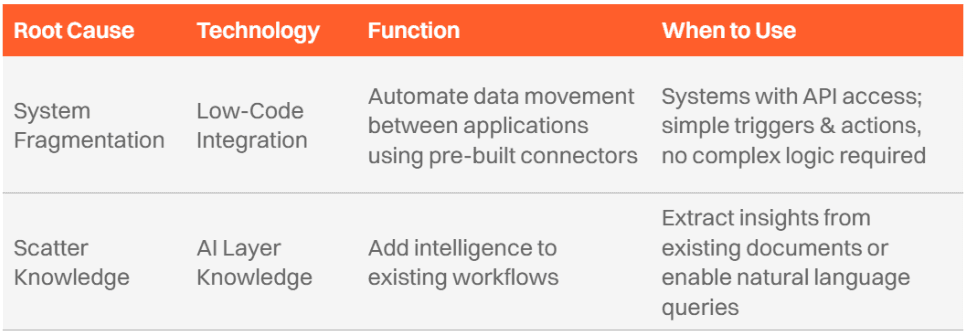
Common tools: Visual workflow builders (Zapier, Make, Power Automate), API management platforms, enterprise integration platforms (MuleSoft, Boomi).
Cost range: $50–$5,000/month, depending on volume and complexity.
Technology Path 2: Greenfield (Build New Digital Process)
When to use: The process relies on paper, email, or legacy systems with no integration capabilities. You need to create an entirely new automated workflow from scratch.
Approach: Implement specialized tools or build custom solutions.
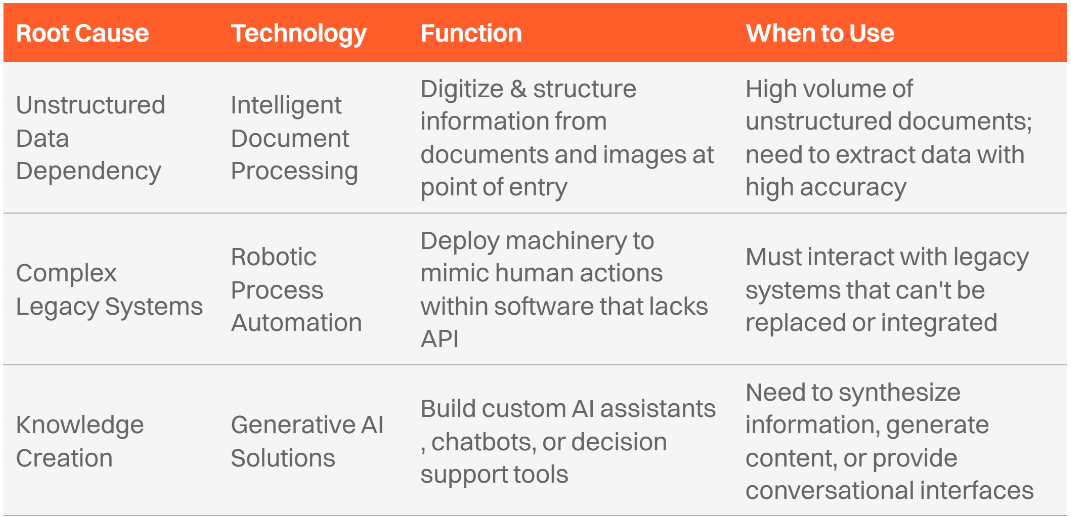
Common tools: Document AI platforms (Google Document AI, AWS Textract, ABBYY), RPA platforms (UiPath, Automation Anywhere), LLM frameworks (OpenAI API, Anthropic API, Google Vertex AI).
Cost range: $10,000–$100,000+ for implementation, plus ongoing licensing.
People
People: Managing Necessary Organizational Change
The success of automation is fundamentally dependent on human adoption. The People stage ensures the workforce is structurally prepared and motivated through disciplined change management.
"Technology is a tool. Its value is realized only when the team embraces the shift."
Strategic Communication: The "Bad to Good" Approach
Effective communication requires setting the right tone by acknowledging the current difficulty before highlighting the future gain. This "Bad to Good" approach provides employees with transparent confirmation of their current workload burden while presenting the change as a direct investment in their professional future.
1. Acknowledge the Burden (The "Bad"):
Communications must start by validating the employees' experience. Directly reference the specific problem identified in the Assess stage and confirm that automation will take over the bulk of that work, quantifying the expected acceleration or time saving. This establishes immediate credibility and transparency.
2. Pivot to Strategic Value (The "Good"):
Immediately shift the emphasis from the task being removed to the value being created. Frame the newly freed time as a resource for individual professional growth and business contribution. Stress that this time is dedicated solely to high-level functions that AI and automation cannot replicate
Formal Change Management & Training
Transform
Transform: Measure the Win & Scale Incrementally
The final stage ensures the pilot project delivers measurable value and establishes the necessary methodology for continuous, scalable growth. Transformation is not complete until the win is quantified and the approach is solidified for the next opportunity.
The Principle of Incremental Change
Successful transformation relies on consistent, small, incremental changes, not month-long shutdowns. Digital transformation must work in alignment with existing operations. Shutting down critical processes for an extended period is ineffective and compromises productivity.
Low-Risk Scaling: By focusing on small automations first (a single step or hand-off), the business minimizes risk. This controlled approach prevents teams from becoming overwhelmed and ensures business continuity remains uncompromised.
Building Momentum: Starting small allows teams to gain confidence, validates the technology quickly, and generates internal success stories that fuel future buy-in and investment.
Measuring Success: The Power of Time Saved
The most powerful metric for validating an automation pilot is the direct quantification of Time Saved. This metric ties the effort directly back to the initial employee feedback from the Assess stage.
Measurement Protocol:
Baseline Comparison: Use the estimated time spent on the repetitive task (collected during the Assess phase) as the baseline.
Quantify Time Saved: After the automation is live, track the actual hours the involved employees are no longer spending on that task per week or month.
Calculate ROI: Convert the time saved into a monetary figure. This calculation immediately demonstrates the return on investment (ROI) and justifies the gradual expansion of the program.
Scaling and Finding the Next Opportunity
Successful transformation is about sustainable momentum. A single successful, low-risk pilot provides the blueprint for expansion.
Strategy for Scaling:
Reusing Capability: The next automation target should be a process that shares similar steps, uses the same data types, or connects to the same applications as the successful pilot. This allows the business to reuse the existing technology stack and established team expertise, making subsequent projects significantly faster and cheaper.
Documenting the Playbook: Formally document all lessons learned, from the successful VoE prompt to the specific exception protocols used. This documentation creates the internal "automation playbook," standardizing the low-risk, incremental approach for future departmental rollouts.
Continuous Improvement: Automation is a cycle, not a destination. Use the new time gained by employees for Process Optimization. They should be encouraged to use their freedom to identify the next most repetitive task that needs to be brought into the ADAPT framework.
How We Can Help
How Silvecko. Can Help
If you are interested in seeing how your business can be more efficient, contact us
Contact Us